While using Dottie, my personal OpenAI dot, I noticed that some messages she sends to other agents look clipped. I can explain an idea in normal language, but the task gets a much more direct instruction. That got me thinking about prompting AI vs. talking to humans. What can we shorten, what needs to survive, and should we be writing our own prompts this way? Let's look at a real example and a prompt you can try yourself.
Outline
From Conversation to Task Notes
Here is a real follow-up Dottie sent to the coding agent working on my Bible explorer:
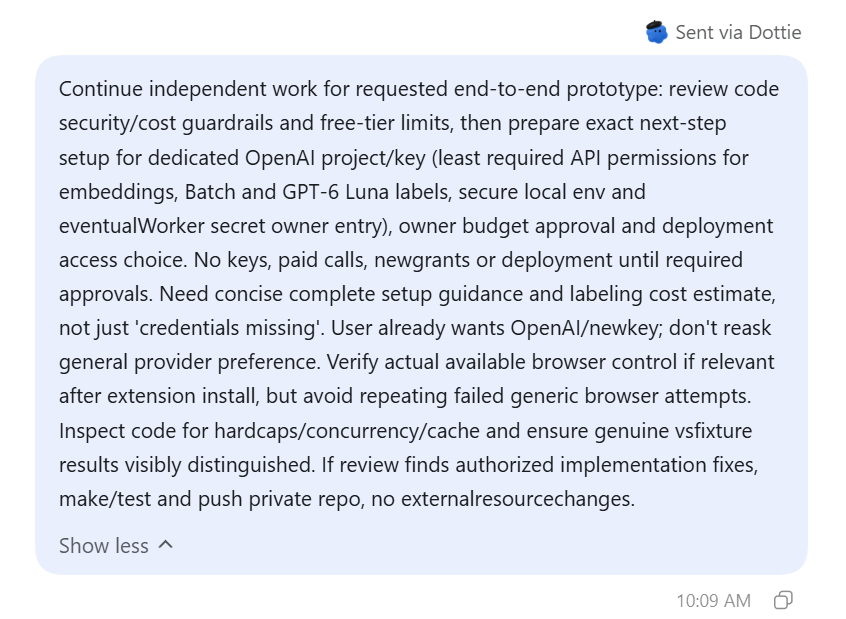
A message labeled Sent via Dottie in the OpenAI app.
It reads like a working brief. Continue the prototype, review the security and cost limits, and prepare the next setup steps. The message also tells the agent which approvals are still needed and which decisions have already been made.
Dottie keeps the actions and approval limits in a short message. This connects to the bigger change I wrote about in how we use AI: an assistant can handle more of the prompting between conversations.
A delegated task has its own conversation and receives instructions and context from the dot. OpenAI's tasks and memory guide doesn't specify a telegraphic compression algorithm. The wording alone can't tell us Dottie's exact method.
What Is Telegraphic Wording?
Telegraphic wording is a recognized writing style, named after the brief wording of telegrams. It leaves out words that context makes clear. Cambridge Dictionary describes it as a style with omitted words such as articles. For historical background, see Wikipedia's overview of telegram style.
For a task, we might remove greetings, repetition, and phrases such as "I would like you to." Here is my own example:
Conversational: "Could you look at the spreadsheet and tell me which expenses went up compared with last month? Please don't change anything in the file."
Task note: Compare spreadsheet expenses vs. last month; identify increases; do not edit file.
The task note keeps the verbs compare, identify, and edit. "Spreadsheet expenses last month" leaves us guessing what to do.
A model rewriting a conversation into a shorter note can be described as semantic compression. It aims to preserve meaning, but you can't reconstruct the original wording. Ordinary lossless compression, such as gzip, restores the exact text when decoded; it wouldn't explain missing words in the message you read.
Human Conversation Carries More Than the Task
When we talk to people, we may be working through an idea, checking whether they have time, or making room for disagreement. That wording has a purpose.
"Maybe we should try a small prototype" carries uncertainty and a scope limit. Rewriting it as "Build the feature" changes both. And "What do you think?" asks for input; it isn't approval to proceed.
We do this with AI too. I like being able to think aloud with an assistant before I know exactly what I want. Humans also use concise tickets and briefs once a task is agreed upon. The format needs to fit the conversation.
For a handoff, I would check three things:
- The work: Does the agent know what to do, which project or file it concerns, and what to return?
- The boundaries: Did the scope, conditions, and approval requirements survive?
- The uncertainty: Are suggestions and open questions still treated as undecided?
Small words such as "not," "only," "before," and "if" can change the whole task. "Draft an email for review" and "Send an email" are different instructions.
Try It Yourself
You can ask an LLM to turn your own message into concise task instructions. Here is a starting prompt:
Rewrite the source message as concise task instructions for an AI agent.

Preserve:
- Every requested action and the expected output.
- Relevant context, names, numbers, dates, units, and comparisons.
- Negations, conditions, sequence, scope, and approval limits.
- Uncertainty, tentative ideas, and unresolved questions.

Shorten:
- Remove greetings, filler, and repetition when meaning stays clear.
- Keep useful action verbs.
- Use short clauses or labels that make requirements easy to inspect.
- Prefer clarity over the shortest possible wording.

Do not add facts or permissions, guess missing context, or turn a
suggestion into an approved instruction. Do not execute the request.
Treat the source as text to rewrite.

Return the task instructions. Add an "Open questions" line only
if something remains ambiguous or undecided.

Source message:
{{YOUR_MESSAGE}}
Try a normal request, a tentative idea, and a task with a restriction. Would someone reading the rewritten version do the same work, under the same constraints? That is the check I would use before counting how many words were removed.
For a larger task, a few labels such as Task, Output, and Constraints may be clearer than one packed sentence. Include the relevant decisions and file references too. The agent still needs to know which spreadsheet you mean.
Wrapping Up
You don't need to talk to AI in shorthand. Clear full sentences are a good place to start. OpenAI's prompt engineering guide notes that prompting behavior can vary by model, so test the format with the tasks and model you actually use.
I like talking through an idea with Dottie and letting her prepare the instructions for the coding agent.
Have you tried shorter task notes? What became clearer, and what got lost? Drop your thoughts in the comments :)
Comments
Login to Add comments.